

Tesla: Autonomy, Volatility, and the Next Industrial Platform
2025-0614

Tesla is no longer just a car company — and hasn’t been for some time. What began as a moonshot in electric mobility has evolved into a broader platform play, centered on autonomy, robotics, AI infrastructure, and data-driven manufacturing. As entrepreneur-investors, we at 24K Research have long tracked Tesla as one of our most traded equities. While the headlines often focus on volatility, personality-driven drama, or missed earnings, our investment thesis remains intact: Tesla is methodically building a vertically integrated AI-native company with leverage across multiple trillion-dollar sectors.
Despite near-term turbulence in both markets and the political landscape, we remain fundamentally bullish on Tesla’s long-term trajectory — particularly around its robotics and full-self-driving initiatives, the upcoming launch of the Cybercab platform, and the downstream businesses likely to emerge around autonomous mobility.
Fundamental Landscape
Adjusted earnings per share (EPS) came in at $0.27, falling short of the $0.41 consensus estimate. Management attributed the softness to transitional pressure from product line updates—particularly the Model Y refresh—and ongoing challenges scaling the Cybertruck platform.
Total deliveries for the quarter reached 336,681 vehicles, down 13% year-over-year. While Model 3 and Y deliveries held steady, the “other vehicles” segment—which includes Cybertruck and early Cybercab units—saw a decline of roughly 40% quarter-over-quarter, with just 12,881 units delivered. This suggests production bottlenecks that are still being worked through.
Tesla’s balance sheet remains strong, supporting continued investment in long-horizon R&D efforts, including the Optimus humanoid robot program and the advancement of its Full Self-Driving (FSD) software stack.
As of mid-June 2025, the stock trades near $325 per share, down approximately 60% from its 52-week high. Despite this, several analysts—including Wedbush—have reiterated bullish outlooks, with updated price targets in the $500 range, contingent on successful Cybercab deployment and sustained FSD software momentum.

Strategic Vision: Autonomy, Robotics, and the Platform Play
Tesla’s long-term strategy is centered on transforming from a manufacturing company to a full-scale robotics and AI infrastructure provider. At the heart of this transition are three key initiatives.
Full Self-Driving (FSD)
Tesla’s vision-only autonomy approach continues to iterate rapidly, powered by billions of miles of real-world data. The architecture is being deployed not just in passenger cars but in preparation for commercial fleet applications. While regulatory headwinds persist — particularly in the EU — Tesla’s U.S. market serves as a testbed for scaling learning loops and pushing updates over-the-air.
Cybercab
Set to begin pilot operations on June 22 in Austin, the Cybercab platform is more than just a rideshare launch — it represents a new mobility-as-a-service business. Tesla aims to own the full stack: vehicle, software, routing, pricing, insurance, and maintenance. This vertically integrated model could offer margin advantages and reduce the need for intermediary platforms like Uber or Lyft. We believe this is a major catalyst if executed to-plan. The latest announcements and videos are impressive.
Optimus
Tesla’s humanoid robot program, Optimus, remains early stage but continues to see real-world deployment inside Tesla’s own manufacturing ecosystem. The medium-term opportunity lies in factory productivity, but long-term, Optimus could evolve into a consumer or logistics platform—possibly becoming Tesla’s most disruptive product line to date. We believe Musk will lead in this extremely innovative humanoid-robotics space over the next decade. Elon Musk outlined a production ambition—5,000 units this year, scaling to 50,000 units in 2026, with aspirational goals toward 1 million/year by 2029. https://www.teslarati.com/tesla-produce-first-legion-optimus-robots-2025/?utm_source=chatgpt.com
Technical Setup & Market Behavior
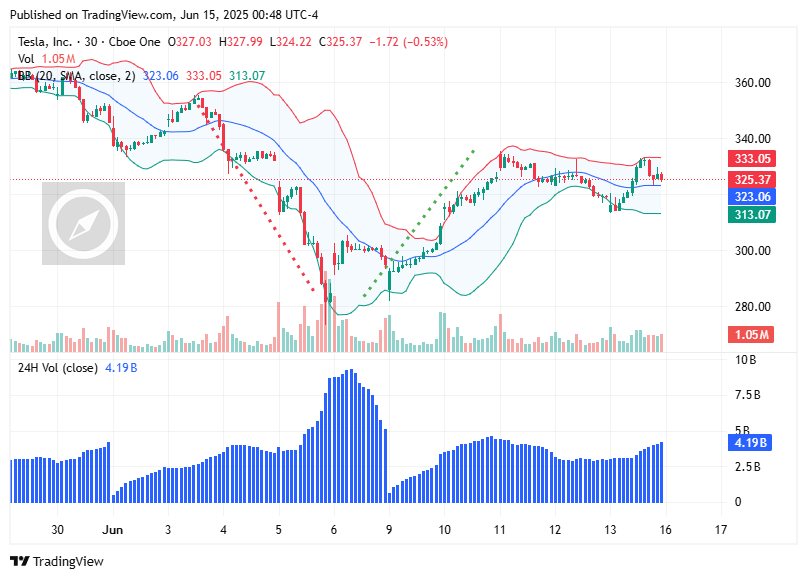
Tesla stock currently trades around $325 after a period of elevated volatility, triggered by both earnings and macro headlines. The stock has formed a technical base near this level following a ~20% retracement. From a chartist perspective, any clear breakout above $350–$360 on volume could reopen upside toward the $400–$500 range, particularly if product announcements or software updates land positively.
Recent trading volumes have remained high, suggesting continued institutional interest even amid pullbacks. As one of the most actively traded names in our own books, Tesla’s intraday volatility creates opportunity for short-term positioning while maintaining a long-term core conviction.
Political & Regulatory Overhangs
Tesla is uniquely exposed to political risk, both in terms of public perception and actual policy.
Musk–Trump Conflict: A recent public spat with former President Trump triggered an approximate $150 billion market cap decline in a single day, driven by fears over subsidy rollbacks and procurement blacklisting. Now as of today, the stock has almost fully recovered at $325, in less than a week it bounced back to its recent trading levels of $315-$330.
Regulatory Scrutiny: FSD continues to draw the attention of U.S. regulators, including the NHTSA. Recent protests — including staged mannequin safety tests in Austin — reflect growing public skepticism around safety and deployment readiness.
China Competition: Tesla faces aggressive competition from Chinese EV and autonomy players deploying sensor-rich, AI-optimized vehicles at lower price points. This places pressure on Tesla’s margins and market share abroad, particularly in Asia and Europe.
While these pressures add headline risk and valuation overhangs, they do not materially change the underlying technology trajectory Tesla is building toward.
24K Research View: A Platform in the Making
We view Tesla through the lens of long-term platform construction. This is not simply an EV story — it is a convergence of mobility, autonomy, robotics, unique energy storage, and AI-driven infrastructure. The company’s greatest asset remains its ability to close the loop between hardware, software, and data across verticals.
We believe the Cybercab launch will mark a pivotal moment: a public demonstration of Tesla’s capability to deploy autonomous mobility at scale, in real-world conditions, under commercial constraints. Combined with ongoing FSD refinements and the maturing Optimus program, Tesla is quietly building a tech stack that could support entirely new business lines in the years ahead.
We estimate ~$1T in market cap add-on potential, on the low side, for Cybercab alone over the next 5 years if executed well. Other analysts like Wedbush are even more bullish, estimating that progress in the Cybercab pilot could drive Tesla’s market cap to $2 trillion by late 2026. ARK Invest’s long-term models attribute a majority of Tesla’s 2029 enterprise value to its autonomous network, projecting a $2,600 per-share expected value in that timeframe — equating to a 7–8× upside from current levels.
Even at modest penetration, say 5–10 million miles of autonomous fleet miles annually, Tesla’s network generates significant software economics: 30–40% revenues from ride-taking margins, low incremental cost of rollout, and OTA data loop advantages previously unseen in transportation.
For 24K Research, the Cybercab is not merely another product line — it’s a platform-level asset and central to our conservative‑bull thesis. Success in the robotaxi business carries the potential to substantially re-rate Tesla’s current sub-$1.5 trillion equity valuation — with upside that could eclipse earlier EV‑only projections.
We remain bullish over the long horizon. Volatility will continue — and in many cases, intensify, making for great trading conditions— and for growth investors with a strong stomach and a deep belief in AI-native infrastructure, Tesla remains a high-conviction position.
Disclaimer: This report reflects the internal views and analysis of 24K Research. It is not financial advice. Always conduct your own due diligence and consult a licensed advisor before making investment decisions.