

BlackSky: Tech & Technical Deep Dive — Eyes in Orbit, Real-Time Upside
2025-06-22

BlackSky has steadily evolved from a niche small-sat imagery startup into a scalable commercial intelligence platform. As entrepreneurs and tech-infra investors, we view BlackSky as a conservative-bull opportunity in the satellite imagery space—striking the right balance between rapid growth and structured operational scale.

Q1 2025 Snapshot: Revenue & Backlog Strength
Revenue hit $29.5 million, up 22% YoY, driven by new contracts tied to Gen‑3 satellite capabilities investing.com+13ir.blacksky.com+13ir.blacksky.com+13simplywall.st+9blacksky.com+9stocktitan.net+9
New bookings exceeded $130 million, lifting total backlog to $366 million (+40% QoQ) tradingview.com+8blacksky.com+8stocktitan.net+8
Cash position sits at $77 million, with $39 million in unbilled contract assets and conservative capex guiding stocktitan.net+4blacksky.com+4investing.com+4
Despite a $12.8 million net loss, operating burn is decreasing and adjusted EBITDA loss narrowed to $0.6 million, down from a $1.4 million loss year-over-year stocktitan.net+3blacksky.com+3ir.blacksky.com+3
Full-year guidance remains intact:
$125–142 million in revenue, $14–22 million adjusted EBITDA, and $60–70 million capex.
Innovation Pipeline & Feature Updates
Gen-3 Satellites (35 cm Resolution, High-Cadence)
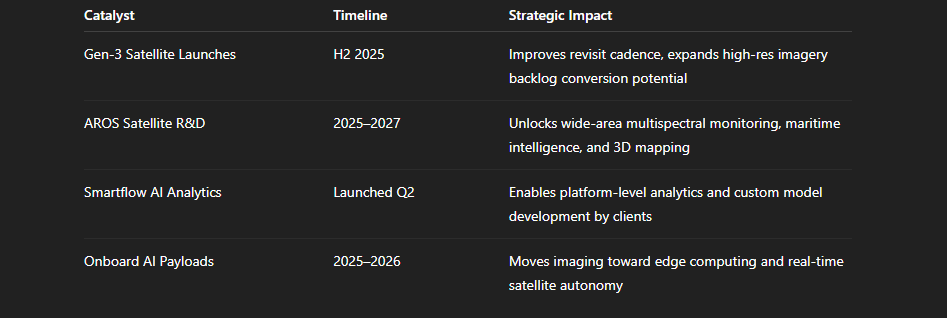
First Gen-3 commissioned in early May — gathering 35 cm imagery, delivering AI analytics within 3 weeks, a month faster than expected en.wikipedia.org+10blacksky.com+10ir.blacksky.com+10
Second Gen-3 launched June 2 aboard Rocket Lab’s Electron, with three more scheduled by year-end, aiming for 8 satellites by Q1 2026 blacksky.com+2spacenews.com+2en.wikipedia.org+2
Gen-3 enables hourly revisit, high-res site monitoring — ideal for defense, logistics, environmental oversight blacksky.com
AROS Multispectral Satellites (Launching 2027)
Unveiled June 16, 2025: AROS satellites will support wide-area multispectral imaging, including maritime and 3D digital twin applications blacksky.com+1thedefensepost.com+1
Optimized for large-area mapping, filling gaps in territory-level digital intelligence as legacy satellites age blacksky.com
AROS: Expanding BlackSky’s Strategic Scope
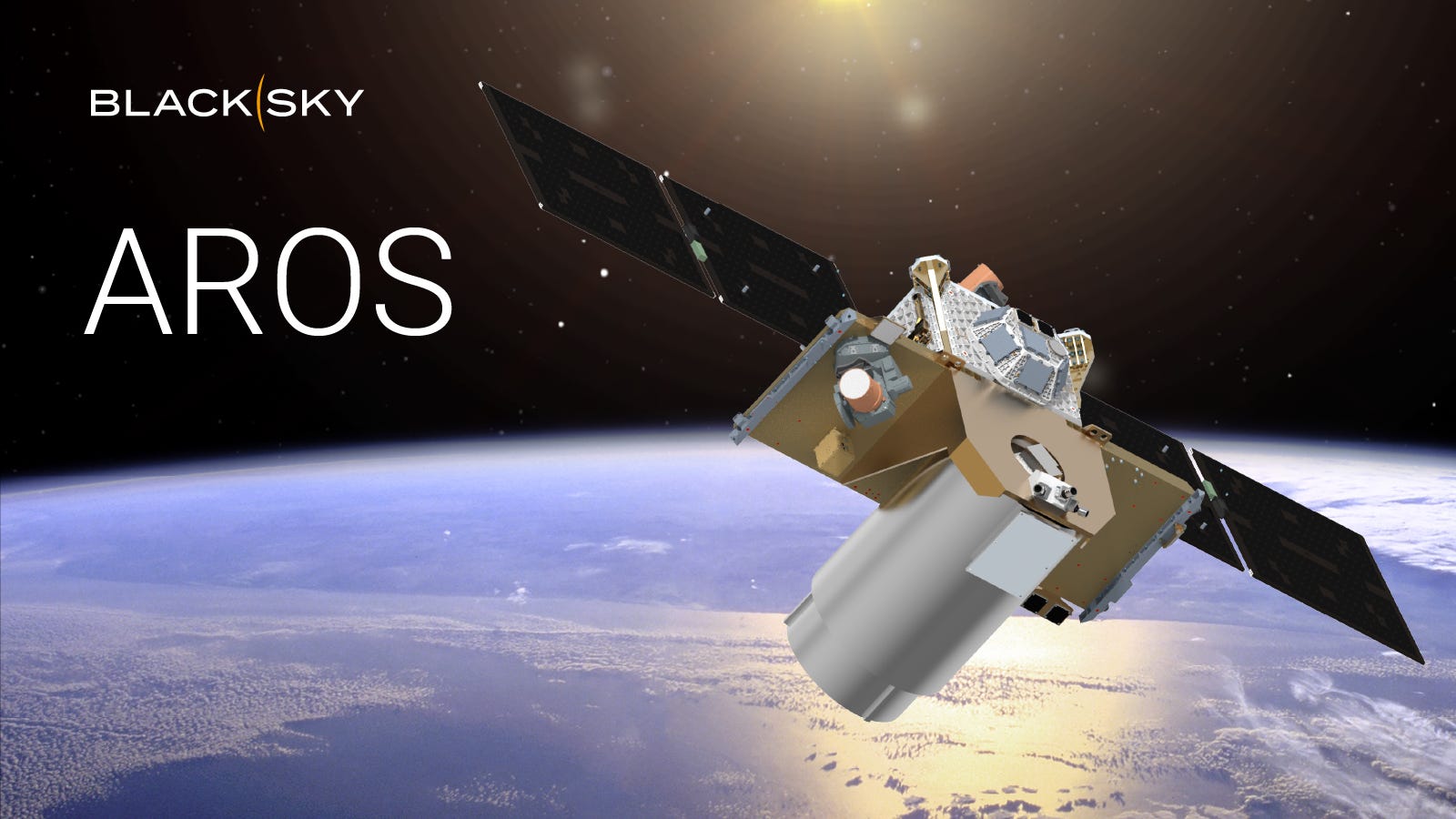
Unveiled in June 2025, AROS marks BlackSky’s next major evolution—broadening the company's offering from tactical site-level imaging to regional-scale intelligence.
Where Gen‑3 focuses on sharp, high-frequency resolution, AROS is engineered for wide-area, multispectral coverage. Designed for launch beginning in 2027, this new constellation will monitor large geographies—borders, shipping lanes, infrastructure corridors—with high revisit rates and multi-band spectral data. It's built for scale, speed, and strategic relevance.
AROS isn't just more satellites; it's a shift in capability. The system operates in a “tip-and-cue” framework—using AROS to scan and detect macro-level changes, then tasking Gen‑3 units for focused follow-up. This dual-constellation approach creates a layered intelligence model—real-time detection fed directly into analytics platforms.
Technically, AROS will feature onboard processing, optical inter-satellite links (OISL), and AI-native architecture—built to integrate directly with BlackSky’s Smartflow analytics engine. The result: faster tasking, tighter feedback loops, and a clearer path to commercial-scale geospatial SaaS.
With LeoStella as its in-house manufacturing arm, BlackSky can build and deploy AROS cost-effectively, gaining control over speed, unit economics, and system integration.
AROS positions BlackSky not just as a provider of imagery, but as a full-stack geospatial intelligence platform—with relevance across defense, maritime, infrastructure, agriculture, and environmental markets.
We’re tracking the rollout closely. While launches are still over a year out, we expect pre-launch contracts, early customer trials, and Smartflow integration milestones to serve as near-term signals of execution strength.
Key Items to Track
AROS launches begin 2027: Wide-area, multispectral satellites for regional-scale monitoring.
Tip-and-cue functionality: Integrates with Gen‑3 for layered intelligence.
Smartflow integration: Real-time analytics pipeline, AI-native from orbit to platform.
Manufactured in-house: LeoStella enables cost control and faster deployment cycles.
New market exposure: Maritime, infrastructure, 3D mapping, and climate intelligence.
Execution signals: Watch for contract announcements, engineering milestones, and Smartflow commercial use cases.
Smartflow AI Platform (Launched June 2025)
An open-source framework (Kubernetes-based) for spatiotemporal geospatial research, enabling neural network detection of construction, activity, and change at scale arxiv.org
Enables customers to ingest imagery, train models, and monitor changes continuously — moving the platform from imagery to analytic insights.
AI On-Board Payload R&D
BlackSky and partners exploring onboard AI-driven beamforming, flexible payload rerouting via ML algorithms (per arXiv research), enabling adaptable satellites with smarter imaging and communications
24K Research Positioning & Perspective
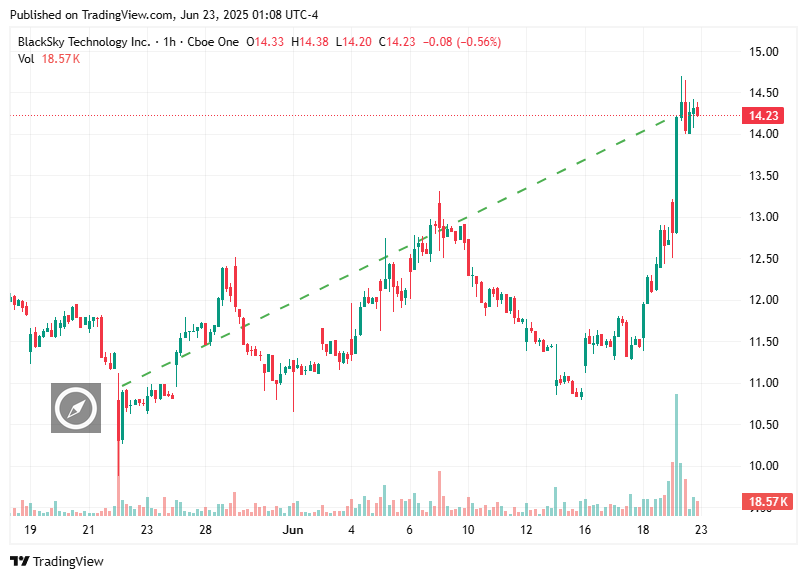
We initiated our position in BlackSky (BKSY) in the $10–10.50 range, aligned with early Gen‑3 deployment and expanding contract wins. As the stock moved decisively through $14.20, we tactically offloaded 25% of our holdings — a proactive adjustment based on technical overextension and momentum indicators near overbought territory.
We remain constructively bullish, but not blindly long. BlackSky’s innovation curve — especially the integration of Smartflow AI, the ramp-up of Gen‑3 satellite cadence, and the longer-term promise of AROS multispectral imaging — points toward a high-leverage, high-utility Earth observation platform with commercial and defense dual use.
What excites us isn’t just the imagery — it’s the potential to build a data analytics business atop orbital infrastructure. If backlog continues to convert and new verticals (maritime, environmental, 3D mapping) begin contributing, prospective revenue could significantly outpace street expectations by 2026.
In the short term, we’re watching for a technical pullback to reposition — ideally in the $12–13 range — where risk/reward improves and RSI resets. We are not chasing momentum; we’re tracking execution, backlog conversion, and satellite deployment timelines closely.
We’ll continue to monitor volume, launch cadence, and software platform traction as the key indicators for our next rotation.
Disclaimer: This analysis reflects the internal views of 24K Research and is not financial advice. Always conduct your own due diligence and consult a licensed advisor before investing.